Breadth First Search
Learning Objectives
- Understand and explain what a breadth first search means in the context of graph theory and what some of the use cases are
- Understand and explain the time complexity of a BFS algorithm
- Ability to implement a simple BFS algorithm
Plain Language Definition – A breadth first search is an algorithm that allows us to answer two questions:
- Is there a path from one node to another
- What is the shortest path between them
Breadth First Search will travel a graph one layer at a time, exploring on a “first come first serve basis”. What this means is that unlike Depth First Search, the algorithm does not travel as far as it can go immediately. The way that it does this is storing nodes that it has discovered in a queue and following that queue in order until it finally either reaches what it is looking for or has explored the entire graph. When thinking about a Breadth First Search (BFS) algorithm, I ran across two very helpful analogies.
The Methodical Dungeon Crawler
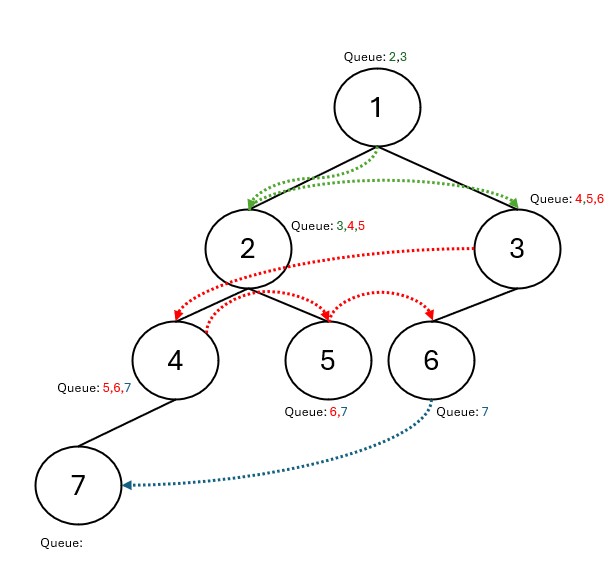
The first example is to pretend you’re an adventurer who has discovered a new cave consisting of many different connected rooms. You want to methodically map out the dungeon so that you explore the cave from closest to the entrance to farthest from the entrance. You don’t want to venture too far with unexplored rooms behind you. You do this by exploring rooms in the order that you discover them.
You enter the cave in Room #1. From there, you see passages to Rooms #2 and #3, so you add both to your list. You explore Room #2 first and find passages to Rooms #4 and #5. You add those to the end of your list, but you don’t go there yet. Room #3 was discovered first, so you backtrack and explore it next, which adds Room #6. Only then do you move on to Rooms #4, #5, and #6, in the order you found them. Room #4 leads to Room #7, which goes on the end of the list and is explored last.
Degrees of Separation
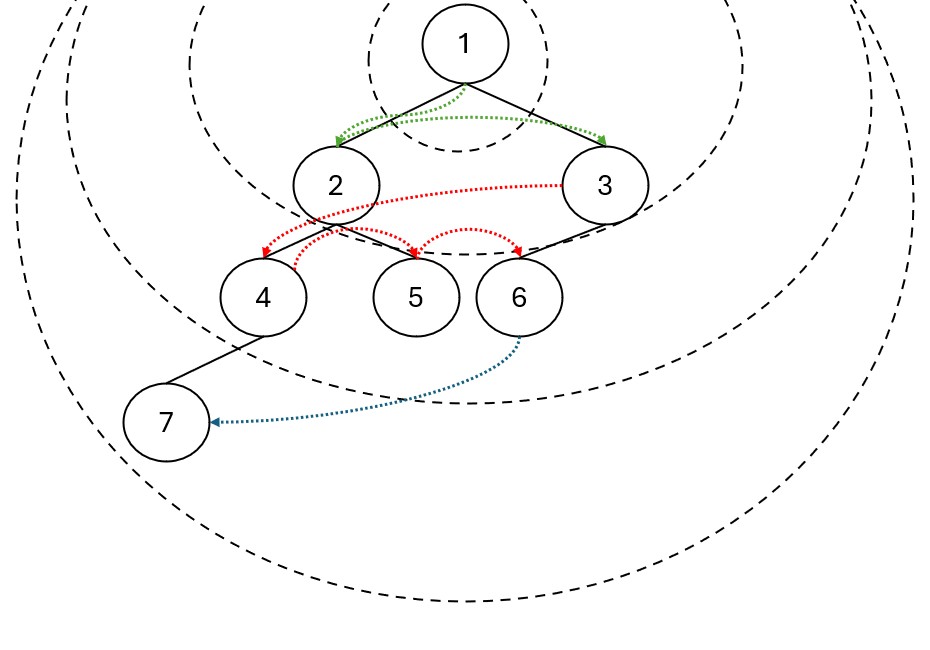
The second example is that you want to find someone in your personal network who has a particular item that you want to buy (let’s say an old SNES video game system). You would prefer to buy from the first person who is closest in your network. That means direct friends (1st degree) first, friends of friends (2nd degree) next, and so on until you find someone who has what you’re looking for. You want to ask everyone in each degree ring before moving to the next degree.
BFS Implementation
breadth_first_search(g: Graph, start: int): list:
    seen: list = [False] * g.num_nodes
    last: list = [-1] * g.num_nodes
    pending: queue.Queue = queue.Queue()
    pending.put(start)
    seen[start] = True

    while not pending.empty():
        index: int = pending.get()
        current: Node = g.nodes[index]

        for edge in current.eget_edge_list():
            neighbor: int = edge.to_node
            if not seen[neighbor]:
                pending.put(neighbor)
                seen[neighbor] = True
                last[neighbor] = index

    return last
Code Source: Graph Algorithms The Fun Way by Jeremy Kubica
Time Complexity
BFS has a time complexity of O(V + E) where V is the number of vertices and E is the number of edges in the graph. This is because each vertex and edge will be explored at most once during the search process.